

|
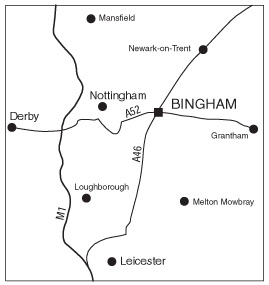
Bingham is a flourishing and growing, small market town in the borough of Rushcliffe in the southern part of Nottinghamshire, which is in the East Midlands of England. Nearby historic towns include Nottingham, Grantham, Southwell, Newark, Loughborough and Melton Mowbray. Situated at the intersection of the A46 (the Fosse Way) and the A52 there is good access by road. Bingham is 20 minutes from the A1 and half an hour from the M1. There are frequent bus services to Nottingham, Newark and Grantham. The east-west railway line links Bingham to Nottingham and Grantham, with frequent connections to the rest of the UK from both. East Midlands Airport is about 40 minutes drive away. The town has a rich heritage. There is archaeological evidence of Stone Age hunters visiting the parish. Late Stone Age and Bronze Age artefacts, an Iron Age settlement, Roman settlement, Anglo-Saxon artefacts and an unexcavated early Medieval village are evidence of continuous occupation of the |
|
parish before the first documented record of Bingham in the Domesday Book. Little evidence of these early periods of occupation remains visible, however, and most buildings older than nineteenth century have been destroyed. The built heritage that contributes to the look of modern Bingham, therefore, is essentially of the nineteenth and twentieth centuries. The countryside around Bingham is flat or gently undulating, mainly arable farmland. There is practically no woodland, nor do any rivers or canals pass through the parish, though there are some significant dykes. There is a network of way-marked footpaths linking Bingham to all the neighbouring small villages and country walks are only ever a few minutes away from any part of the town. A popular one is the Linear Park, which follows a redundant railway track. It has a rich flora and fauna and is managed as a recreational facility by the Town Council. |
|
Bingham has grown considerably
since the early 1960s as hundreds of new houses have been built
on peripheral green fields around the core town. There has also
been a certain amount of infill development where large gardens
that were remnants of the orchards that once flourished in Bingham
have been sold as building plots. The population in 2011 was 9,131. |
||

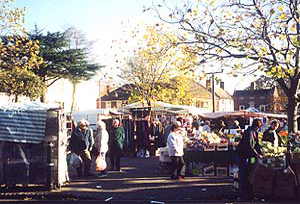
Bingham market on a November morning (Photo: Peter Allen). |
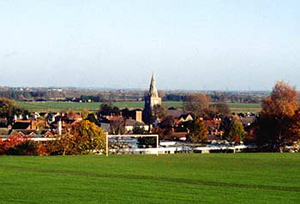
Bingham from Toot Hill school playing fields (Photo: Peter Allen) |

For details about the services and facilities in Bingham go to the Bingham Town Council web site www.bingham-tc.gov.uk